Sunday, July 3, 2016

Storyteller-writer Jackie Kerin


Dragon head in a woodland near you

Acknowledgements


Thank you to our former President of The Australian Fairy Tale Society, Dr Belinda Calderone, new President Catherine Snell, committee, presenters and other participants for an inspiring annual conference and AGM of The Australian Fairy Tale Society on Sunday 26 June 2016 in the Glen Eira Storytelling Festival, Caulfield, Melbourne.

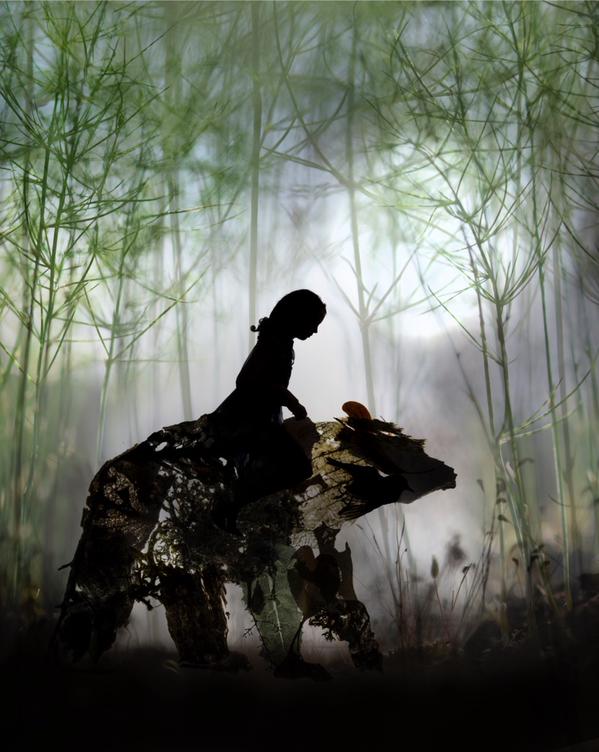
Lorena Carrington's photographic illustration was used, with her kind permission, to create this year's conference program, designed by Gypsy Thornton
We welcomed new members (boosted by Bel and Jackies' representation on ABC Radio) as well as voting in a new committee including Catherine Snell as President & Treasurer; me as Vice President; Penelope Clay as Secretary; and Jo Henwood and Thang Dac Luong as committee members.

From afar, we welcomed valued committee member Gypsy Thornton, an Australian fairy currently based in the United States of America. Gypsy not only designed the programme but also managed a live Twitter feed of the conference, as well as updates at Facebook and Instagram. Since our Society's foundation, she has been a constant source of inspiration, whether through social media, blogging, email, Skype or those flights of fey communication that nudge our dreams.

"The Stolen Child" by Lorena Carrington
AFTS co-founder, historian, librarian & cultural tour guide Jo Henwood, visiting from interstate, gave a brilliant impromptu storytelling, replacing a sick fairy, while Jackie Kerin and Thang Dac Luong signed copies of their respective books, Lyrebird and Refugee Wolf. Illustrator and photographic artist Lorena Carrington, AFTS fairy tale ring member, who designed our programme and social media banner, sold her prints in the Auditorium, e.g. pictured right.

Zeinab Yazdanfar (AFTS fairy ring member) and her fellow representatives of The Yarra Foundation, which helps disadvantaged children to obtain books, sold original Persian glassware, painted tiles, jewellery, textiles and other crafts, with 100% proceeds to charity, while presenting, as a poster, a fairy tale co-written with me entitled "Passage Under Rood Khan", set to appear in a future posting at this fairy tale ring blog.

Our accomplished keynote Jackie Kerin, President of Storytelling Australia Victoria, demonstrated links between historical research, intercultural respect and dramatic performance skills, in purveying the oral tradition, which many see as the folk-blood of fairy tales. So it's appropriate that we now present an interview with Jackie.

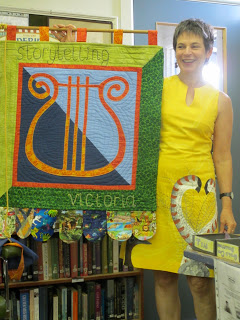
Jackie Kerin at Australian Fairy Tale Society conference 2016

Jackie holding a candle for storytelling
Storytelling Australia Vic banner


Interview with storyteller & writer Jackie Kerin


Introduction 


Jackie is storyteller and author with a deeply cosmopolitan outlook, steeped in the oral tradition, using such cumulative patterns as rhyme, rhythm and repetition to convey stories. Currently President of Storytelling Victoria Australia, Jackie has won many awards for her books and performances. She believes that oral storytelling is connected to the book like blossom to fruit.

Jackie Kerin, storyteller and writer
Interview

L: How, when and why did you become a storyteller? It was through the storytelling community that we first met, nearly 20 years ago.

J: I think I’ve always been a storyteller but I only labeled myself as such about 15 years ago. I first attended a gathering of storytellers in 1997 – 98 (hosted by the Storytelling Guild) and slowly, from that time, my commitment to learning about the art grew. Coming from an acting background, I had much to learn. I came to storytelling with a bag of skills to get me started but I lacked knowledge and the ability to work without a script. In the early 90s I was drawn to the work of American humorist, Garrison Keillor and later, when I had my daughter I discovered the joy of telling her stories. I’d also spent a few years prior to this in the western desert and listened to Aboriginal storytellers. I was excited by the idea that I could use my performance skills in a new and independent way. Unlike acting, I was free to choose the stories I wanted to tell. 

L: Congratulations on winning The Spirit of Woodford Original Stories and Yarns Performance Award 2007, 2012 and the Pat Glover Memorial Port Fairy Festival Award 2002, 2007, 2009. What are some festivals you’ve particularly enjoyed as a performer? 

J: Awards are fun and let’s face it – its nice to tag your website with a gong. But they come with the stress of competing and being judged. The incentive to enter Woodford is a free ticket to the festival (which you receive if you are short listed) and if you win, then the prize money covers all the travel and accommodation costs. But the best part is getting there and being inspired by musicians, storytellers and poets from around Australia and overseas. I couldn’t have afforded to go to this festival if it wasn’t for the award. 

The Pat Glover at Port Fairy is a quieter event. Often the entrants are farmers with tales of irrigation ditches, fishing trips, snakes and spiders – tall tales mixed in with yarns of rural adventures and mishaps. I love hearing stories from people whose lives are different to mine. This year I travelled to Port Fairy with my collaborator Sarah Depasquale. As well as working for the Pat Glover Award, I was asked to give a workshop and sit in a ‘round robin with other storytellers on the subject of Celtic Tales. Sarah and I also performed two shows of Tales from the Flyway, our piece inspired by migratory shore birds. 

The Newstead Shorty Story Tattoo has a wonderful event at the Newstead racecourse around big bonfires. 

Probably my favourite festival event is the one I organise for Storytelling Australia Victoria for the Newport Folk Festival every year – ‘Stories by the Fire’. SAV tellers take on the MCing for me (Matteo, Niki na Meadhra, Kate Lawrence, Ian Mcnally and Teena Hartnett have all helped). Claudette D’Cruz donates the chai and I cook up a pot of soup. The evening is an invitation to people to gather, eat and share a story. 

This July, I’m off to the Huon Valley Mid-winter Festival where I’ve assisted in putting together a collection of wonderful local Tasmanian storytellers for family sessions. But as well as this we are launching the inaugural Huon Valley Storyteller’s Cup. This is a slam and there will be cash prizes as well as a beautiful hand crafted Huon Pine cup. Every festival has its own value and unique feel.


L: As president of Storytelling Australia Victoria, how do you see the organisation’s evolution since its origin as The Storytelling Guild of Victoria?

J: This is a hard question for me to answer, as I am not really up to speed with the history of the organisation. I joined after the big conferences and events at Lorne. One of the tasks of the new committee has been to gather some of the stories from the past. This is not easy; memories have faded. It’s a work in progress. Hopefully we will soon have more information to post on our website and maybe this will prompt more memories. As they say ‘story begets story’. We’ve been though the long process of reviewing our values and purpose and recalibrating the organization in response to the influx of new members who come with broad interests and from all around Victoria. 

L: What is your longterm vision, or passionate hope, for the storytelling community in Victoria? 

J: Oh I have a grand vision! Firstly to pass on all the contacts I have made over the years, knowledge gained and lessons learned. And eventually, when I hang up my hat, I’ll pass on my props. I’m growing old and need to think about pulling back. I imagine SAV as a network where people can connect, form creative collaborations, share resources, and experience. I want us to make safe and supportive places; where people can be brave and try things out, make mistakes. I want to encourage storytellers to be curious about global, oral storytelling traditions – keep learning, set up study groups. We currently have several Facebook Groups exploring The Mahabharata and Japanese Kamishibai. In the past we have dabbled in the Canterbury Tales, Arabian Nights and The Mabinogion. We have members with a strong interest in personal storytelling and running workshops and slams. I want to support them. We need to learn more about recording and broadcasting. I’d like to see more storytellers filming their work so we can share what they do. I’d like to offer workshops for tellers wishing to work in early childhood, with the elderly and special needs. We need to provide regular forums, open and inclusive where we can learn from storytellers who may feel marginalised. I see a building, with computers, staff, an urn, mugs and a fridge!!!

L: Yes, wouldn't that be great? I believe it might be possible, if enough of our associations work together, not only toward grants but also in sharing physical space for meetings and resources.

J: Most of all, I have a vision a community of committed, kind, curious, and creative storytellers and listeners who will support each other in crafting stories and events with heart.

L: Indeed, you've proven that this is possible, at countless conferences, festivals and other gatherings. How does our storytelling circuit already interweave with Australia’s fairy tale revival, and how could this evolve further? (Notwithstanding only some storytellers are into fairy tales, and not all fairy tale enthusiasts are storytellers, perhaps there are some overlaps emerging?) 

Port Fairy Folk Festival: Jackie Kerin & Sarah Depasquale
J: There is more work to be done in strengthening the relationship between SAV and the Australian Fairy Tale Society, Monash Fairy Tale Salon and Victorian Fairy Tale Ring. This is something I would like to focus on. Ask me again in 12 months time. Personally, my interest in stories is without boundaries and the inaugural AFTS conference and the Monash Fairy Tale Salon events have provided the most enriching, thought provoking and enjoyable times for me. I particularly like the blend of the academic with performance.

L: Recently the Australian Fairy Tale Society, of which you and I are members, called for resources on Beauty and the Beast. You made the fascinating recommendation of Bhima and Hidimbi in the Mahabharata. Tell us more?

J: Hidimbi is a flesh eating forest dwelling ogre-like creature who falls in love with the handsome strong Bhima, so she changes her shape into a beautiful woman. They spend a year together an she bears a son. More here.  

L: Would you please tell us more about The Mahabharata Project? How do people join, and what events do you have coming up that fairy tale enthusiasts might enjoy? Any fees?

J: You can find the Mahabharata Group on the Storytelling Vic website under Groups. It’s a Facebook Group, so any one can join and there are no fees. I know some people don’t like Facebook as a way of meeting but when I set it up with my friends Gerry and Kala, we wanted to reach people in Asia who have grown up with the stories. We currently have 112 members. It’s a very informal conversation. People will post a story and a discussion will start. We worked towards a presentation for the Newport Folk Festival and we’ve done a house concert. I’ve incorporated some of what I’ve learned into my repertoire and it’s certainly enriched my relationships. I’m not sure if Fairy Tale enthusiasts would enjoy the stories; I can’t predict that. If people are interested in dipping a toe in the water of the longest story in the world, I suggest they read on a kindle where they can access Wikipedia as the names and allusions are hard at first. Jaya by Devdutt Pattanaik is good starting point. One of the unexpected outcomes from the project for me has been the connection to storytellers in Bali, India, Singapore and Malaysia. We have become friends, above and beyond the project.


Scene from The Mahabharata showing Arjuna kidnapping Subhadra and fury of the Yadavs - from cravebits

L: You are also a talented writer, Jackie. Who are your literary mentors? Which stories (or other modes) have you particularly enjoyed reading over the past year or two?

J: I wouldn’t say I have a mentor. I’m indebted to my publisher and editor who opened the door to the publishing world and processes. I’m a great collaborator and love working robustly, with ‘gloves off’ and with strong creative minds. I like to work with people who will challenge me. I like collaborating with people who are direct and understand that it’s not personal. It’s about getting to the ‘good oil’. Perhaps it’s from my acting background. I learned (eventually) to leave my ego in a bag when I’m working, so I can be brave and really challenge myself and allow others to challenge. My reading is all over the shop. I’ve just read The Garden of Evening Mists by Tan Twan Eng, Girt: The Unauthorised History of Australia by David Hunt Strange Tales from A Chinese Studio by Pu Songling and The Comfort of Water: A River Pilgrimage by Maya Ward. I’m a painfully slow reader and with the exception of children’s books, have all but abandoned paper books. I have moved so much in the past and taken truck-loads of books to op shops and traders. And now many op shops won’t take them. I keep the books I know I’ll revisit but they are mostly reference books and anthologies.


L: Your email signature lists CBCA Honour Book 2013 and Whitley Awards Certificate of Commendation 2013 for Lyrebird! a true story and Eve Pownall CBCA Noteable 2009 for Phar Lap the wonderhorse. Is CBCA an acronym for Children’s Book Council of Australia? Please direct us to some retailers or websites for these books here...


Lyrebird - A True Story - by Jackie Kerin
J: My books are available in ‘all good book stores’ as they say. Museum Victoria published them, so they are always available in the MV shop. Coles bought 500 copies of Phar Lap for the 2015 racing season. So I guess for a while I was there in the aisles! The books are easy to find on line and Lyrebird! A true story is available as an ebook as well.

L: Which museums, libraries, clubs, or other groups have nourished your writing, from conceptualization and research, to editing, printing and marketing? 

J: Both books, and fingers crossed for a third, have been published by Museum Victoria. Both books were nourished by meeting people connected to the stories and visiting locations. In the case of Phar Lap, I met an old strapper who had seen Tommy Woodcock working with horses. Both stories are set in the late 1920s 30s so listening to people talking who grew up in that time, noting colloquial expressions and slang; visiting locations like old stables or in the case of Lyrebird, I made countless trips to Mt Dandenong to the forests and gardens. The State Library, Museum Victoria and Trove were also invaluable. Testing the stories on countless children, talking to bird lovers, horse lovers and more testing the stories on children. The best marketing of a children’s book is recognition from the CBCA. And I think that the best way to learn if story has legs is to try it out on the people you are writing for … so… more testing on children. 
Pages from Jackie Kerin's book Lyrebird - A True Story

L: Your books and oral storytelling show a strong focus on Australian fauna and history, most notably Phar Lap the wonderhorse (illustrated by Patricia Mullins) and Lyrebird! a true story (illustrated by Peter Gouldthorpe), both published by Museum Victoria. How did you become impassioned by environmental and historical themes?

J: In the case of Phar Lap, I saw a gap. There was no children’s book about the legend and every year around November when I was telling stories in schools, there was an interest in the story. So I wrote one. I stumbled across the story of Edith and her Lyrebird and thought ‘this is a great tale – the first Lyrebird filmed and recorded in display, a smart, strong old women and a bird. Magic!’
Regarding environmental themes. To me connection to land and the environment is critical: always and ever. Connection to nature and taking some responsibility for my local environment is a moral imperative. Stories are one way to lend support to the councilors, rangers, various authorities etc. So that’s one of the things I try to do. Being creative for the pleasure alone, feels like shallow pond. I like to think that my contribution is useful, beyond entertaining.

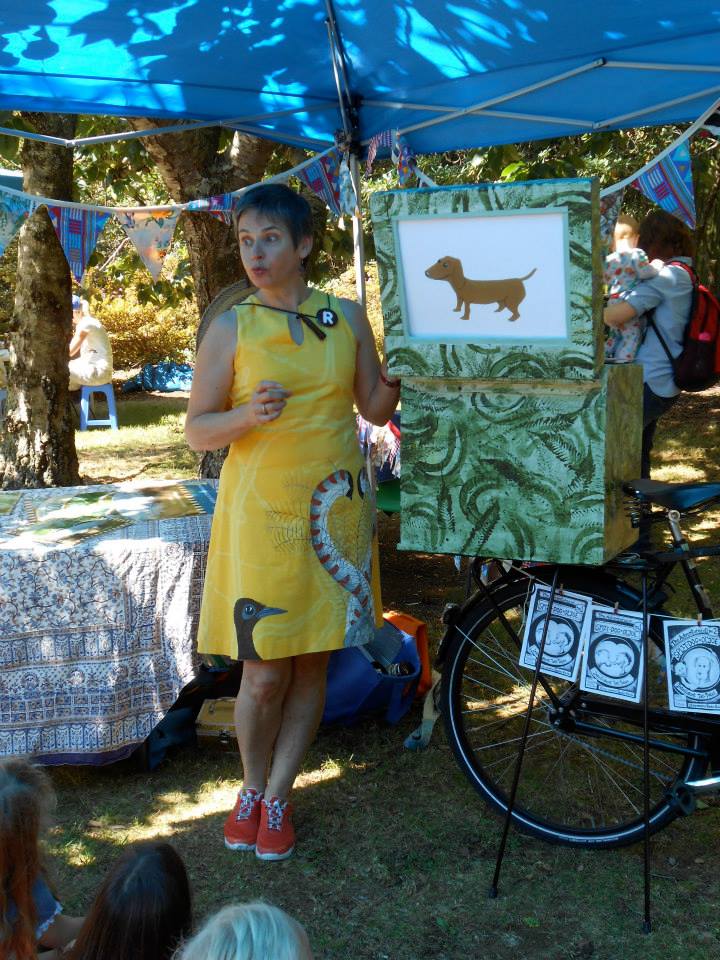
L: You have adopted the Japanese Kamishibai tradition (which involves carrying a flat wooden box that opens out like a puppet theatre, containing picture cards that the storyteller draws out to illustrate narrative). It was the origin of Anime and Manga, right? Here are some photos of you on your story-bicycle with your own handmade kamishibai...
Jackie Kerin on her Kamishibai bicycle
Jackie Kerin, storyteller, in Bunnings hardware store
J: Always exploring. I like drawing and painting and visual storytelling. I’m passionate about comic books and graphic novels. I think stories have a place on the street and in all kinds of settings and Kamishibai is a great way to deliver them. The pictures work to focus minds in distracting environments. That photo with the Kamishibai (above), was taken in a Bunnings hardware store. I was working for Eastern Regional Libraries. It’s one of my favourite photos. I worked for about five hours telling stories to many children who never go to libraries and have limited access to books and storytelling. We were in the outdoor furniture department.

Mariam Issa at RAW Garden
In Shakespeare’s day people performed fine entertaining works in the street. It’s a skill many still practice but more often with a circus twist. Hats of to those who every summer take plays into parks, hay sheds and gardens. (E.g. storytelling sessions hosted by Mariam Issa, for Resilient Aspiring Women - RAW Garden, pictured left - L.)

L: In an October 2015 post for Storytelling Australia Vic, you outlined a pertinent resource for storytellers wishing to incorporate Aboriginal words into stories: the Victorian Aboriginal Corporation for Languages. Would you please share some of that learning here?

J: The Victorian Aboriginal Corporation for Languages (VACL) has brilliant website that is constantly adding resources. You can also follow them on Facebook. It’s up to the storytellers to check it out. There is also a wonderful Vic language map in Bunjilaka in Museum Victoria. VACL gives public lectures and if you follow their Facebook you can track these. The work being done on the first languages in Victoria is very exciting.

L: Anything else?

I invite people to visit the Storytelling Australia Victoria website, subscribe to the blog, hop onto Facebook and join in the fun. There is something for everyone in this network of people who love listening to and telling stories: true stories, tall stories, yarns, funny and sad stories and yes… fairy stories. Vic storytellers can be found in humble halls, grand museums, around log fires, in gardens and propped up at the bar. When you become a member of Storytelling Australia Vic, you become part of a community of passionate wordsmiths with capacious hearts. We pride ourselves on our hospitality and openness to new tellers and their projects.


Visit Jackie’s website

Many thanks for your time, Jackie.

Article by Louisa John-Krol, incoming Vice President of The Australian Fairy Tale Society.


Thursday, June 16, 2016

Artist Lorena Carrington

"Ferny Vista" by Lorena Carrington

Interview 


with photographic artist and illustrator

Lorena Carrington


Introduction:


In 2015 I met a remarkable photographic artist, Lorena Carrington, at Apple Annie’s cafe in Castlemaine, in Victoria’s gold region. Several images by Lorena lined the walls, including one that I subsequently bought (pictured below). Lorena is a member of The Australian Fairy Tale Society and most of her themes allude to this rich wellspring of inspiration.


"The Spider's Gift" by Lorena Carrington


Conversation:


LJK: How do you create your images? It seems you apply a unique way of mixing raw natural materials with sophisticated computer technology. Please tell us all about your technique and its purpose.

LC: Thanks Louisa. You’re absolutely right - it’s the balance and disparity between the raw materials (dried leaves, twigs, bones etc.) and the technology that allows my works to come into being that I find so compelling.  I collect the ingredients for the images, and photograph them as individual objects.

I use a lightbox to back-light smaller items, and photograph larger objects in the studio or even against the sky to silhouette them. They are then montaged together in Photoshop to create the final image. 

LJK: One of my favourite pictures of yours is entitled “The Spider’s Gift” (also known as “Hot Air Balloon”, pictured & cited above) though I tend to refer to it as “Dandelion”. What are the materials you used to create that image?

LC: The white dandelion shape is made of steam, in this case from a morning cup of tea. The black threads are spiderweb, and other detritus - spider skins, seed pods, etc. The background was photographed near Lavers Hill in the Otways, one of my favourite places in Victoria. 

LJK: All this was a mystery to me when I bought it. For me it captures the essence of a dandelion's contradiction: transience yet continuity, as the seed dances. I like how its simplicity hides complexity of construction, like nature itself.


"The Fox Bridge" by Lorena Carrington

LC: My most technically challenging piece was “The Fox Bridge” which is comprised of over 70 separate photographs. Some friends found a (mostly) whole fox skeleton on a walk in the bush and brought it back for me. It was just a pile of bones at that point, so I photographed them to scale, then digitally pieced them together again. More fun than a jigsaw puzzle!

"The Metamorphosis" by Lorena Carrington
I usually create the silhouettes first, then layer in images to create a background. The files are then sent off to the printer, where they are printed using the Chromira process (using an LED printer to expose true photographic paper) and then mounted into an aluminium or high density foam core backing.

LJK: What is your favourite fairy tale, or fairy character?

LC: One of my favourites is a little known Celtic story entitled “The Stolen Bairn”, published by Sorche Nic Leodhas in Thistle and Time, a book of Scottish tales. 


Visit the link here.


"The Mother's Gift" from The Stolen Bairn by Lorena Carrington

It is also the first story in the wonderful collection Fearless Girls, Wise Women & Beloved Sisters: Heroines in Folktales from Around the World

LJK: What attracts you to this tale?

LC: I love that it is a tale about a single mother who rescues her own child. She receives advice from an elder woman, but she is the active character throughout. One of the things I find most frustrating about the contemporary versions of our most popular tales (Cinderella, Sleeping Beauty, etc.) is that the main (female) protagonist is the one with the least amount of agency, while the ever dashing prince ends up getting all the action, but is always a lifeless two dimensional character. Not fair on either of them! 

LJK: For that tale you created a pair of pictures - “The Mother’s Gift” & “The Mother’s Gift II” (2014) - displayed online and in a postcard set that you gave me, thank you. The heroine made two offerings: one to enter the elf kingdom; the other to bargain for her child. Tell us more?

LC: In the tale, a woman falls from a cliff while foraging for food, and her baby is taken by Sídh (Scottish fairies). She is nursed back to health by a fisherman’s family, then goes out to search for her child. She weaves a shawl from scraps of wool and her own hair, and because it is made with the magic of a mother’s love, it is the softest material you could ever feel. She also makes a harp from bits of bone and driftwood she finds along the shore, and strings it with her own hair and again, because it was made with the magic of a mother’s love, it plays the sweetest music you have ever heard. She buys her way into the Sídh gathering with the shawl, and plays the harp for the king, who is holding her child. He insists on owning the harp, so she bargains for the return of her son. 

I created the two images, showing one of the gifts in each. I hope they also convey some of the emotions she must be going through: the lack of solid ground under her feet, the swelling of ocean water, the swirl of stars in inky skies, and the circular intense concentration on what must be done to get her through this time time of loss and grief. And most importantly hope. 

LJK: Your piece about Baba Yaga is quite haunting. What does this character represent to you?
"The Bone Lantern" by Lorena Carrington

LC: Ah, the Baba Yaga! She is one of my favourite characters in fairy tales. She is the Russian witch of the woods. Versions of her are present in tales from all round the world, but she is far more than the cliched crone we know from Hansel and Gretel. Yes, in some tales she is wicked, but in others she is the powerful ‘Earth Mother’. She controls the winds, and only seeks to protect the woods that she presides over. She is powerful, unapologetic, and doesn’t take any nonsense from those foolish enough to stumble into her path. I love her. 

But it is her house that I love almost as much. It has its own mind, walks around on chicken legs, and will only let you enter its door if it chooses to. 

It even challenged me in the making of that image. To photograph the legs, I crawled around after a friend’s chicken for a good half an hour, rolling around their patio on my belly while the hen, with incredible dignity, kept just out of sight of the camera lens. 

LJK: How did you hear about The Australian Fairy Tale Society? Why did you join? Which members have you met, in person or online, so far - and in what context? 

LC: I attended a symposium “Into the Woods” at The University of Melbourne’s Centre of Excellence, where I met the wonderful Dr Rebecca-Anne Do Rozario from Monash University. I had heard of the Society before then, and had always meant to join, but Rebecca gave me the high-heeled kick I needed!

LJK: What are some of your wishes or hopes for this Society?

LC: The Society is doing a marvellous job extending our knowledge of fairy tales and debating their meanings and origins. My hope is that we can keep broadening the public’s ideas about fairy tales. They are not simply static tales of ‘Once upon a time’ and ‘Happily ever after’. They are a rich, evolving, and essential part of our cultural community. I’m so excited that the conference is in Melbourne this year, and can’t wait to meet up with so many like-minded souls.

LJK: Where did you study art? 

LC: I studied Visual Art at La Trobe University in the late ‘90s. This was back in the old days of film photography, where we spent all day in the underground darkroom subsisting on tarry coffee, chemical fumes, and the local pop radio station. I loved every minute.

LJK: Who helped shape your skills, ideas and knowledge?

The Merman by Edmund Dulac
LC: My visual fairy tale influences include Golden Age fairy painters such as Arthur Rackham, Edmund Dulac and Kay Nielsen. Photographically I have also been drawn to modernist photography, and the work of Tina Modotti, Edward Weston, Laslo Maholy Nagy et al. While it might not be obvious in my current work, I think their simplicity and love of contrast, tone and form still come through.

As for the tales themselves, I have a growing collection of books on my desk. Grimm of course, especially the raw, dark and often very bizarre first edition of their stories that was released last year. I often come back to Fearless Girls, Wise Women & Beloved Sisters: Heroines in Folktales from Around the World. It’s a brilliant collection, edited by Kathleen Ragan. Marina Warner’s book From Beast to Blonde has been a great inspiration too, along with Bruno Bettleheim’s The Uses of Enchantment.

Contemporary writers inspire me too - especially the incredible number of Australian women writers currently exploring new facets of fairy tales: Nike Sulway, Kate Forsyth, Margo Lanagan and Danielle Wood in particular. And we can’t forget Angela Carter of course. 

LJK: Agree! Sophie Masson is great, too. In Spring 2015 you exhibited in Port Fairy. How did that go?

LC: That was my latest solo show, and one of my favourites. Lots of people came to the opening, and were all delightful and intelligent and kind, and I’m sure it wasn’t just the champagne talking.  Blarney Books and Gallery is run by the wonderful Jo Canham. She and her husband Dean (and two children) have created an incredible space. So much more than the sum of its parts: bookshop, gallery, performance space.

"Storywind" by Lorena Carrington
LJK: You’ve have had at least 6 exhibitions over the past year. Congratulations! That’s a lot of exposure - and a lot of work. What are some contexts in which you’ve presented your art recently?

LC: Yes, 6 exhibitions in a year was a little more than I’d recommend! Especially as they were fitted in around other projects. I love exhibiting, but it’s a lot of work, and expensive too, with the cost of printing, gallery hire, openings etc. I’m always thrilled to break even, which thankfully nowadays I mostly do. 

As well as traditional exhibitions, I do try to diversify. In 2014 I presented a three dimensional installation at the Bendigo Library as part of the Bendigo Write on the Fringe Festival, which was a delightful challenge. You can watch a video about it here.

"Lindworm" by Lorena Carrington
Last year I held a series of workshops with kids at local schools and libraries, on silhouette-based illustration, which was enormous fun. I hope to do it again.

I’m also moving into illustration work, which I love more than life itself right now. 

LJK: Do you prefer to work solo, or in collaboration? Or a little of both?

LC: Creating images for exhibition, I definitely prefer to work on my own, but I love collaborating with others on projects. Whether it’s with other artists for exhibitions, or illustrating for writers, there’s some immensely satisfying and surprising about working with another creative brain.

LJK: What are some advantages that you foresee in interdisciplinary presentations?

LC: It’s the creative surprises that excite me the most. I get such a thrill when a collaboration creates something that neither of us could have imagined on our own. I read voraciously, so of course love working with writers - I’ve been lucky enough to work recently on a project where the writer and I worked in tandem. While I created images around her writing, she in turn spun words around my images. It was a rare and wonderful privilege.

Writing and illustration feed each other. Together they add depth and nuance to the other.

LJK: What are some challenges for artists in your field?

LC: I hate to say it, but money is probably the big one. Exhibitions are expensive, easily costing a couple of thousand dollars every time, so it’s stressful if work doesn’t sell as well as hoped. As an illustrator, we invest just time but, as with writing, a lot of effort goes in before any hint of return. Even when most of us are in this for more than money, we should be paid fairly. The popular image of the creative industries is that because we love what we do, that should be payment enough. 

LJK: Ah yes, that attitude is pervasive. People have no idea of the implications for artists' lives. 

LC: The creative industry can be a frustrating one to be in. I could keep ranting for a long, long time, but I won’t. I love what I do, and I’m incredibly lucky to have to freedom to be able to do it. My partner and I run a photography business and that helps pay the bills.

LJK: Please tell us about a memorable turning point or seminal moment in your artistic life. It might be something you read, someone who mentored you, or a place you visited...
"Ship" by Lorena Carrington

LC: In 2008, I hadn’t made much work for several years. Having two children will do that to you.  Then, along with several other Castlemaine artists, I put together a group exhibition based around the Willow Pattern story; the English-created Chinese ‘myth’ accompanying the widely loved crockery design. Layering the willow pattern design onto the Australian landscape was the beginning of my silhouette work. It was a small leap from the blue of the willow pattern, to black silhouettes of fairy tales illustrations. 

A couple years later, I was in another show themed around ‘journeys’, and I focused on the journey and quests within fairy tales. That exhibition helped focus my developing interest in narrative and fairy tales through photography. And here I am, still reading fairy tales. 

LJK: What is the artistic / intellectual life like in Castlemaine and its region these days?

LC: Castlemaine is an incredible place for artists, writers, musicians and other creative souls to live. I heard that we have the highest rate of artists per capita in the state (maybe even the country?), and I’m sure writers aren’t far behind. We have the Castlemaine State Festival every two years and Arts Open in the years between, and so much else happening all the time. We have quite a few overlapping communities, from painters and potters who have been here since the ‘70s, to new waves of multimedia artists and designers moving in. We all bump up against each other like beans in a pot, and amazing things come of out it. 

LJK: News of a current or forthcoming project, studies, shows, or other plans for your art? 
"Beauty and the Beast" by Lorena Carrington

LC: I’ve sworn off exhibiting in 2016, and am focusing on putting my head down and creating, but I did write an article ‘Adolescence in Fairy Tales’ and supplied their cover image for the latest (April-May) issue of The Victorian Writer. It’s available here 

I’ve given myself a hermit-year, where I’m making new work, writing, and researching some new topics. I’m particularly interested in the representation and allegorical possibilities of adolescence in fairy tales and, somewhat relatedly, transformation myths. 

LJK: Why “The Bone Lantern” - the name of your blog

"The Bone Lantern" by Lorena Carrington

LC: I had already created an artwork of the same name, and the image sums up what I’m trying to achieve through my work. As with fairy tales, there is always light through the dark, but the darkness too is essential. Death (the bones) and life (the light) together illuminate the soul. I’m always very conscious of the balance and necessity of both. It also sounded vaguely like a newspaper banner. That was good enough for me! 

* * * * *


While we’re sharing links I can also be found via my website here
and on Twitter @lorena_c.
Here again is Lorena Carrington's Blog

LJK: Thanks for your time. I look forward to seeing more of your work at the 2016 Australian Fairy Tale Conference next Sunday. Oh, and we love the front cover you designed for our flier!

LC: Thanks Louisa! 


* * * * *


Tuesday, June 7, 2016

History: Vic Storytelling Logo


Logo of Love - No Harp, No Story?

Article by Louisa John-Krol 7th June 2016


This piece is part of a History series for our storytelling community, which overlaps with our faerie realm. There are, naturally, areas where no such cohabitation occurs. My fey blog is a point where those circles touch. Perhaps even glinder, glimmer and gleam. Ok, I made up the word 'glinder'. We can never have too many verbs. Especially in stories! 

Post-beam editing is possible, so you're welcome to notify me of oversights. I'm grateful for contributions so far. 

Forthcoming articles include an exploration of how Victoria's first Storytelling Guild came to be, with focus on co-founder Nell Bell. For now, you can read a report on our visit to Nell, in an earlier post here.


After co-founding The Storytelling Guild of Australia (Victoria) in 1978, renamed Storytelling Australia Victoria in 2012, storytellers Monty Kelly and Nell Bell designed our first Guild logo, a black fairy bearing a harp / lyre against a red background. According to Nell, they wanted to make a connection with the bards of old. Storyteller Anne E Stewart found this 1990 image (above), echoing the world’s first fairy shop, Wonderwings, where some of us received mentorship under the Guild’s aforementioned co-founder, Nell. This image appeared on the cover of the Guild's original newsletter, The Harper.

Design by illustrator David Wong

David Wong, illustrator
The Storytelling Guild’s single harp / lyre against black & white background came later. David Wong designed this logo. The black & white logo was designed as letterhead (above), and formed the basis of the current logo (below) of Storytelling Australia Victoria.


Next, along came green badges featuring a map of Australia with gold border. Monty and Nell designed the badge, pictured below:

Original Badge of The Storytelling Guild of Australia (Victoria)
There was also a cream banner featuring a gold harp / lyre on our green insignia, with green and gold tassels (below):

Original Banner of The Storytelling Guild of Australia (Victoria)
Below: storyteller Susan Pepper viewing designs for a more colourful banner, including one in a sketchpad, and a quilt that appears to be silk embroidery.

Below right: resulting quilted colour banner, still in use today, 2016.

Storyteller Susan Pepper
Storytelling Vic banner work-up (above left) & final quilt banner (above), still in use 2016


At first glance, our logo seems to herald Celtic lore. Partly true. “After all”, writes Californian storyteller-harpist Patrick Ball, “Celtic harp has always been used to accompany the telling of Irish tales. Tall tales, tales of little people and hard lands, stories of love and loneliness - these reflect the Celtic soul”; Patrick has released albums of stories with harp music since 1983 on Celestial Harmonies / Fortuna Records. 

There is a Welsh flood story of the village Ys on Alan Stivell’s album Renaissance of the Celtic Harp, an influence upon Canadian singer-harpist Loreena McKennitt (evoking Pre-Raphaelite poems); also upon Andreas Vollenweider, a multi-instrumentalist. Early Welsh poet Taliesin was depicted playing harp, and some associate him with Ceridwen’s cauldron of inspiration, and with The Mabinogion, the earliest prose literature of Britain. Scholars suggest there were probably two Taliesins; the first dating back to the 6th century; the second chronicled in medieval manuscripts.

The Irish harp Uaithne belonged to the Dagda, an important god in Irish mythology: a protector of the people. His magical harp played itself! One of the most revered of these harpists was Turlough O'Carolan, who was blind. Born in Ireland in the 18th century, O'Carolan (pictured below) was also a composer and singer. 


Harps were burned and harpists executed, as travelling harpists were thought to stir rebellion amongst the Irish people. Such music often accompanied bards reciting poetry. The Celtic Triangular Harp was known as the instrument of the Bards.

Right: Plate from Historical Memoirs of the Irish Bards by J.C. Walker

Naturally, the bardic harp was as much a part of Scottish culture as it was of Irish and Welsh.

The harp is a multi-stringed instrument. Its strings are made from a variety of materials including wire, silk, nylon or gut. Their plane is positioned perpendicularly to the soundboard. Although in the category of Chordophones (as are all stringed) the harp has its own sub category, Harps. All harps are made up of a neck, resonator and strings. Frame harps also have a pillar. Harps without a pillar are known as open harps. Smaller harps can be played in a lap, but more often stand beside the harpist. Most popular in Ireland is the folk harp. Additionally, Nell recalls a book entitled The Bard by Morgan Llewellyn.

Yet, according to Nell Bell, the logo also alludes to the Greek Lyre of Orpheus, revered bard of classical antiquity, for example in the legend of Jason and the Argonauts.  Centuries later, he reappeared in the medieval romance Sir Orfeo, garnering longevity of troubadours, of Italian fairy tales and French salons. Greek bards were often employed as Praise Singers, e.g. to promote an Olympic athlete.

The image below, courtesy of Mark Cartwright, Encyclopaedia of Ancient Art, portrays a lyre that resembles a harp.

Ancient lyre
Daemonia Nymphe instrument: barbitos


A modern Greek ethereal world band, Daemonia Nymphe, established by Spyros Giasafakis and Evi Stergiou, currently based in England, has revived ancient instruments from their heritage, such as lyre, barbitos and pandoura (from the lute family), constructed by Nicholas Brass with authentic materials of antiquity, often accompanied by recitals from odes, Orphic or Homeric hymns, and Sappho’s poems for Zeus and Hekate. Their theatrical shows feature masks and robes of their own design. Other harps in ancient Greece included the trigonon and piktis.


By the Renaissance, the most popular instrument in the Western world was not harp or lyre. It was the lute. Still the legacy of linking music to words continued, not only in the courts, streets and alehouses, but in playhouses, providing accompaniment to Elizabethan plays. Later, studio recording rekindled that marriage of music and word, e.g. “Shakespeare Songs” by the Deller Consort (1967) on Harmonia Mundi. 

A Dutch Harp festival (DHF) in 2014 carried the theme No Harp, No Story, “a direct reference to the harpist’s original function as a teller of tales and gatherer of news”. No Harp, No Story is at the website of Remi Vankesteren.

Remi Vankesteren

For thousands of years, the harp has been the instrument of storytellers, from ancient Egypt to our medieval troubadours and minstrels.

Priscilla Hernandez of Yidneth, Spain
Spanish ethereal singer/composer/illustrator/multi-instrumentalist Priscilla Hernandez is pictured above playing harp in faerie costume, courtesy of her realm Yidneth.

Toumani Diabaté
Today in Africa, if someone is playing a harplike instrument, the Kora, it is said that this person can contact the spirits and this way receive stories from them. One of Africa’s most important musicians is Toumani Diabaté, born in Mali. Hailing from a distinguished family of Griots (hereditary historian-musicians), he plays the Kora, a harp unique to West Africa, with 21 strings. You can hear and view his performances at his website.


Kora - ref: Kaypacha

Metaphorically, our instrument might just as well be a fiddle, didgeridu or drum. A reed in the hands of a Pied Piper. It need not even imply accompaniment. It is a directive, a symbol of power, a tool that casts a spell like a wand or staff; or sends a signal: “my turn to speak”, as in tribes that pass around the speaker’s rod.

In Australian indigenous culture, music and storytelling are deeply entwined in imparting ceremonial (or other) traditions. Most Aboriginal instruments are in the idiophone class, wherein instruments consist of two parts joined to form a percussive sound. Throughout the continent, this takes many forms, including membraphones (skin drum types). There are no chordophones or stringed instruments, though there are aerophones (wind instruments). Regardless of physical form, the purpose of Aboriginal music is to keep culture alive. In this, words are paramount.

Indeed, language itself can be musical. An instrument is a reminder, a key. Could this be the meaning of the phrase “No harp, no story”?

      The Harp that Once Through Tara’s Halls             
Thomas Moore 
(1779–1852)

The Harp that once through Tara’s halls
The soul of music shed,
Now hangs as mute on Tara’s walls
As if that soul were fled. So sleeps the pride of former days,
So glory’s thrill is o’er,
And hearts, that once beat high for praise,
Now feel that pulse no more.
No more to chiefs and ladies bright

The harp of Tara swells:
The chord alone, that breaks at night,
Its tale of ruin tells. Thus Freedom now so seldom wakes,
The only throb she gives,
Is when some heart indignant breaks,
To show that still she lives.